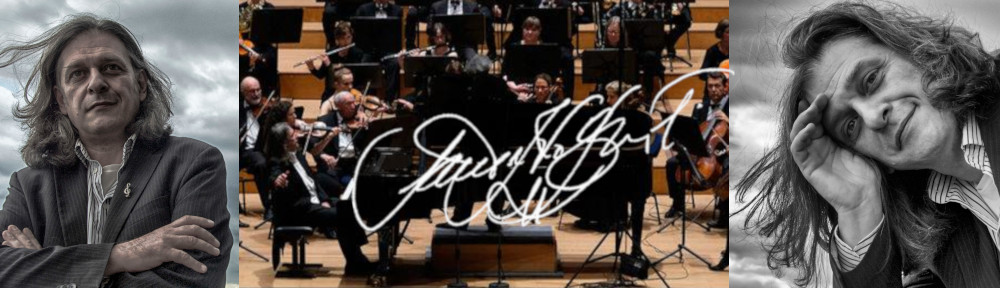
Sandro Ivo Bartoli.
SANDRO IVO BARTOLI.
Sandro Ivo Bartoli responded to the devastation of the Covid-19 pandemic with a monumental online project: the complete performance of Domenico Scarlatti’s 555 Sonatas, broadcast daily through his social media channels from his studio in the Tuscan countryside. Each Sonata was introduced individually in an informed yet conversational style. The project achieved significant international acclaim and remains the only complete video recording of the Scarlatti Sonatas freely available, hosted on Sandro Ivo Bartoli’s YouTube channel.
Described by La Nazione as “one of the foremost Italian pianists active today” and hailed by the German press as “one of the most important musicians to have emerged from Italy in the past thirty years” (Dresdner Neueste Nachrichten), Sandro Ivo Bartoli was born in Pisa in 1970. He studied at the Conservatory of Florence and the Royal Academy of Music in London, later perfecting his art under the legendary Russian pianist Shura Cherkassky. Establishing himself as the leading interpreter of early twentieth-century Italian repertoire, he has performed with prestigious orchestras including the Philharmonia Orchestra in London, the Maggio Musicale Fiorentino, the Hallé Orchestra, the Saint Petersburg Philharmonic, the Deutsche Radio Philharmonie, the Johnson City Symphony Orchestra, and the Mozart Chamber Orchestra.
An artist of vigorous style since his early career — at his Swedish debut, the Svenska Dagbladet praised him as “a virtuoso beyond this world” — Bartoli is drawn to the late Romantic virtuoso repertoire and is distinguished by a sound rich in tonal nuances. He has earned critical acclaim with performances of concertos by Rachmaninov (notably the Third Concerto in London and the Rhapsody on a Theme of Paganini at Manchester’s Bridgewater Hall), Shostakovich, Beethoven, Franck, Chopin, and his beloved Liszt (Totentanz at the Philharmonie in Munich, Concerto Malédiction at the Bad Elster Festival).
In recent years, with performances of Rachmaninov’s Second Concerto in Dresden, Tchaikovsky’s First Concerto at the Herkulessaal in Munich, and bold explorations of solo repertoire — such as the monumental Fantasia and Fugue on the chorale “Ad nos, ad salutarem undam” by Liszt-Busoni, Liszt’s enigmatic Grosses Konzertsolo, and Rachmaninov’s First Sonata — Bartoli has emphasized an audacious, virtuosic approach to his piano artistry. This direction has been confirmed by an intense recording activity, which has earned him numerous accolades, including the Diapason d’Or Découverte for the complete piano concertos of Gian Francesco Malipiero (CPO) and the 5 de Diapason for The Frescobaldi Legacy (Brilliant Classics).
His impressive discography features many rarities, including complete recordings of the Bach-Busoni and Liszt-Busoni transcriptions, and original works by Ferruccio Busoni (Fantasia contrappuntistica, Elegies) and Ottorino Respighi (Concerto in the Mixolydian Mode, Toccata, with Michele Carulli and the Saxon State Orchestra).
In 2015, Bartoli began a collaboration with the German label Solaire Records, making his debut with the first-ever recording of Franz Liszt’s Franciscan works, immediately acclaimed by international critics as a landmark interpretation (“undoubtedly one of the best piano albums of recent years” — Fidelity Magazine). With Solaire, he subsequently released a Bach album — winner of the Supersonic Award by Pizzicato magazine — and a recording devoted to Puccini’s piano music, enthusiastically received (Artist’s Pick of the Month by Textura and Collector’s Choice by iClassical, Grammy Nomination).
Bartoli has recently completed triumphant tours of Japan and the United States, where audiences at the Concerts from the Library of Congress honored him with a standing ovation. He was also acclaimed for a recital in Berlin (“a magnificent recital” — Fidelity), and performed with the Abruzzo Symphony Orchestra (Rachmaninov’s Second Concerto) and the Brașov Philharmonic (Anton Rubinstein’s Fourth Concerto). He appeared at the Lucca Classica Festival to commemorate the 50th anniversary of Gian Francesco Malipiero’s death.
In May 2024, Amadeus magazine published his recording of Rachmaninov’s Second Concerto and First Sonata.
Several composers and musicologists have dedicated works to him, including Giancarlo Cardini, David Plylar, Nimrod Borenstein, Dominy Clements, and Erik Lotichius. An eclectic artist, Bartoli has also worked in theatre, composing the music for The Book of Disquiet by Pessoa (adapted by Antonio Tabucchi), staged at the Avignon Festival.
He is the subject of two documentary films: Pianiste/Interpréte (M. Sebestik, Paris, 2005–2014) and Mood Indigo (G. Besseling, Amsterdam, 2013).